Chapter 3
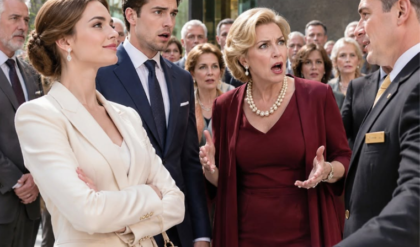
Her smile disappeared.
"You're turning this into a war."
"No. I'm protecting their inheritance."
She folded her arms.
"You need to understand something. Michael and I are their parents. We make decisions for them."
"Absolutely. But you don't own their money."
Her expression hardened.
"You've always used money to control Michael."
I almost smiled.
"Rebecca, I haven't paid a single one of your bills since Thanksgiving."
That caught her off guard.
"What?"
"The automatic payments have stopped. The grocery assistance,
the car insurance supplement, and the monthly transfer you never mentioned to Michael. All stopped."Her face changed.
For the first time, she looked genuinely frightened.
"You can't do that!"
"I can. Those were gifts, Rebecca. Not obligations."
She stepped closer.
"After everything we've done for you?"
I stared at her.
"What exactly have you done for me?"
She opened her mouth, then closed it.
I picked up my handbag.
"Give the children a hug for me."
As I walked toward the front door, I heard her whisper:
"You'll regret this.
"I didn't turn around.
Two weeks later, the situation became much worse.
A social worker arrived at my house.
She introduced herself as someone conducting a preliminary welfare inquiry following concerns raised by a family member.
She asked whether I lived alone.
Whether I managed my own medications.
Whether I had experienced memory problems.
Whether I had recently given away large amounts of money.
I answered every question calmly.
I showed her my medical records, bank statements, and the independent cognitive assessment Margaret had arranged.
The assessment showed no evidence of cognitive impairment.
The social worker seemed uncomfortable.
"Mrs. Harwood, I want you to understand that we're required to investigate reports of possible vulnerability."
"I understand."
She looked at her notes.
"Your family member expressed concern that you might be financially manipulated by someone outside the family."
I raised an eyebrow.
"Did that family member mention my daughter-in-law?"
She didn't answer.
After she left, I called Margaret.
Within an hour,
we had documented the visit.Then Margaret told me something I hadn't expected.
"The report was submitted anonymously, but the wording matches the guardianship petition."
I sat down.
"Rebecca."
"Likely."
"She's trying to make me look incompetent."
"Yes. And now she's creating a paper trail."
I looked at Thomas's photograph.
He had always been the calm one.
When I became upset, he would take my hand and say, "Edith, don't let someone else's chaos become your responsibility."
I wished he were sitting beside me.
I wished I could ask him what to do.
But then I remembered something.
Three weeks before he died, Thomas had asked me to promise that I would never let anyone pressure me into changing the children's trusts.
At the time, I had thought he was simply being cautious.
Now I understood.
He had known something I hadn't.
I found the letter in his study.
It was inside the bottom drawer of his desk, beneath an old leather folder containing our marriage certificate and the children's birth announcements.
The envelope was addressed to me.
In Thomas's handwriting were four words:
For Edith. When necessary.
My hands trembled as I opened it.
"My darling Edith,
If you're reading this, someone has probably begun questioning your judgment or trying to interfere with the children's future.
I hope I'm wrong.
But during the last year of my life, I became concerned about Rebecca's growing interest in our finances.
She asked several questions about the children's trusts. At first, I assumed she was simply curious.
Then she asked whether the money could be released if Michael and Rebecca experienced financial hardship.
I explained the restrictions.
She didn't seem satisfied.
I want you to know that I have not changed the trusts, and I never intended them to become a source of support for Michael's household.
The children deserve a future that belongs to them.
But there's something I haven't told you.
Last spring, I discovered that Michael had accumulated significant personal debts.
I offered to help him establish a repayment plan.
He refused.I also discovered that some of the financial difficulties were connected to Rebecca's business.
I didn't tell you because you were already worried about my health.
I asked Victor to monitor any unusual inquiries involving our family assets.
If something happens to me, please be careful.
I love our son.
But loving him doesn't mean protecting him from the consequences of his decisions.
Protect the children.
And protect yourself.
Forever yours,
Thomas."
I read the letter three times.
Then I cried.
Not because Thomas had hidden something from me.
Because he had spent his final months worrying about the possibility that his own son might betray us.
The next morning, I met Victor and Margaret.
We reviewed Thomas's findings.
Rebecca had previously owned a small interior design company.