Chapter 13
His attorneys attempted to argue that he had acted without knowledge of the larger scheme.
But the recording from the observatory directly contradicted that defense.
Madeline also provided a full statement.
She admitted receiving money from Julian and described the discussions surrounding Claire's removal from the ownership structure.
She was not granted automatic immunity.
She had to answer for her own conduct.
But her testimony helped establish the timeline.
Then, in March, the authorities recovered one final piece of evidence.
A message from Julian to Richard, sent three days before Christmas.
Claire found the old files. We need to get her signature tonight. If she refuses, I'll make sure she can't interfere again.
The message was timestamped.
The investigators had the original device.
There was no dispute about its authenticity.
Claire read the message in silence.
Then she placed the phone on the table.
“He was planning it.”
I nodded.
“Yes.”
“He knew what he was doing.”
“Yes.”
She looked at me.
“Why did I keep trying?”
I sat beside her.
“Because you loved someone who kept promising to become the person you needed.”
She wiped her eyes.
“I thought if I left, I would lose everything.”
I took her hand.
“You lost nothing by leaving him.”
She looked at the window.
“I lost five years.”
I considered that.
“You lost time. But you still have your life.”
She nodded slowly.
Then she said:
“I want to go back to school.”
I smiled.
“What would you like to study?”
“Architecture.”
I looked surprised.
“You used to draw houses when you were little.
”“I still do.”
She smiled faintly.
“I want to design homes for people who need a fresh start.”
I felt my eyes fill.
“That sounds beautiful.”
She looked at me.
“Maybe I can start with this house.”
I glanced around the room.
Daniel's old house.
The place where we had hidden from the world.
The place where Claire had finally found safety.
“Then let's make it yours.”
PART 15
The divorce proceedings concluded several months later.
Julian agreed to a settlement that restored Claire's independent financial rights and removed his access to her protected beneficiary interest.
The court confirmed that the disputed transfer documents could not establish a valid assignment of her ownership.
The civil case continued against the relevant Sterling entities.
Richard's company underwent a major restructuring.
Several subsidiaries were sold.
The government contracts were reviewed independently.
The Sterling name, once associated with prestige, became synonymous with a corporate scandal.
Julian's criminal proceedings were separate.
The Christmas Eve incident was investigated alongside the broader allegations.
Claire provided a detailed statement.
The medical records supported her account.
Emily's testimony confirmed that others had witnessed the events.
The balcony recording showed Julian's conduct.
And the financial evidence established that his treatment of Claire had occurred during a larger effort to pressure her into surrendering her rights.
At the hearing, Julian looked toward Claire several times.
She never looked back.
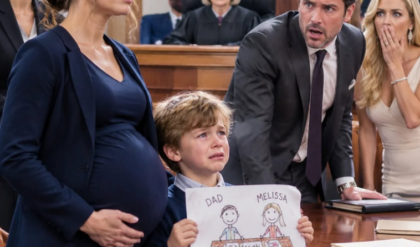
When the judge asked whether she wished to make a statement, Claire stood.
Her voice trembled at first.
Then it became steady.
“For five years, I believed my marriage was something I had to save.”
She paused.
“I believed that if I was more patient, more understanding, and more forgiving, my husband would stop hurting me.”
The courtroom was silent.
“But I eventually learned that I was not responsible for his decisions.”
She looked toward Julian.
“He didn't throw me outside because I was a bad wife. He threw me outside because he believed I had become inconvenient.”
Her eyes filled.
“He thought I had nowhere to go. He thought my mother was powerless. He thought money could make everyone look away.”
She took a breath.
“He was wrong.”
Claire sat down.
I reached for her hand.
The judge acknowledged her statement.
Then the proceedings continued.
Julian's lawyers attempted to challenge the evidence.
But the documents, recordings, financial records, and witness testimony formed a consistent pattern.
The court did not accept his attempt to portray the events as a simple marital disagreement.
And for Claire, that mattered more than anything.
For years, she had been told that what happened inside her marriage was nobody else's business.
Now the truth had been heard in a public courtroom.
She no longer had to carry it alone.
PART 16
One year after that Christmas Eve, the first snow of December fell across our property.
Claire stood on the porch wearing a cream sweater.
Her hair was longer.
The bruises had disappeared.
The scar on her wrist had faded.
She held two cups of coffee.
“Mom?”
I turned from the window.
“Coming.”
She handed me one.
“Do you remember what you said when you found me?”
I looked at her.
“I said you were safe.”
She nodded.
“And you were right.”
I smiled.